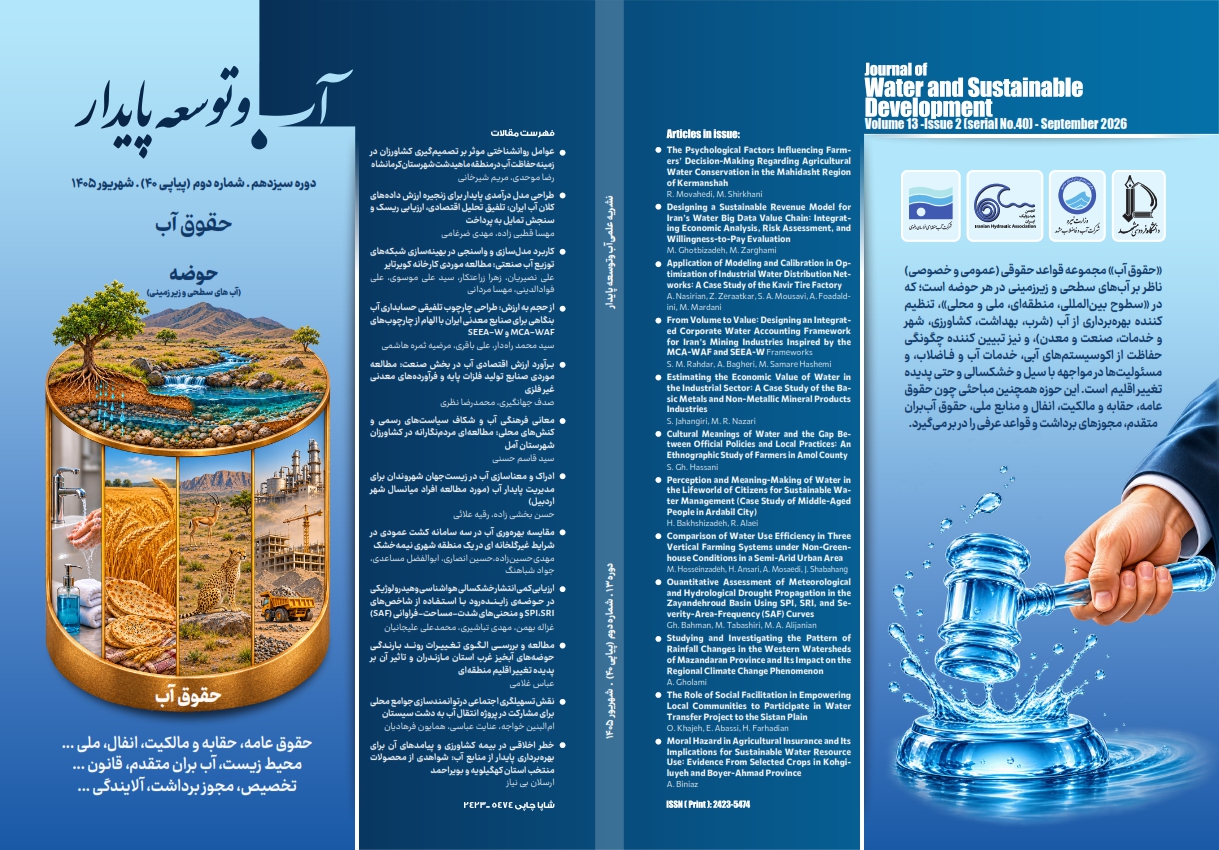
Water Rights
Water and Conflict of Interest

 Journals Metric

Number of submissions

1,411

Number of published articles

600

Number of Authors

1,151

Number of Article views

1884795

Number of Reject Articles

764

Reject Rate

54

Number of Accept Articles

527

Acceptance Rate

37

Average time of Preliminary review of received articles

7 Days

Average Time to Accept

130 Days

Average time to submit an article until publication

230 Days

Number of Reviewers

684


Evaluation of scientific journals in Iran (2021-2022): Rank A

Evaluation of Islamic World Science Citation Center (ISC) in 2019: Q2 rank and impact factor: 0.19


The Journal of Water and Sustainable Development has established in 2014 in the form of Biannual by the Ferdowsi University of Mashhad with the financial support of Mashhad Water & Wastewater Company. This Journal has been published as a Quarterly since December 2019.

This journal is an output of joint scientific activities between the Ferdowsi University of Mashhad and the Hydraulic Association of Iran.

The Quarterly Journal of Water and Sustainable Development is published by the Ferdowsi University of Mashhad. The JWSD considers and publishes original peer-reviewed research monolingual articles (Persian) from the results of experimental research, theoretical analysis, and modeling (numerical and experimental) in all

1- Water management and economy

2- Risk, sustainability, and resilience

3- Surface and groundwater resources

4- Irrigation and agriculture

5- Water transfer and hydraulic structures

6- Water quality, recycling, and wastewater

7- Water, ecosystem, and environment

 All articles of the Journal are Open Access: They are immediately available online at no cost to accept, read, distribute and/or reuse. 


Water Management and Economy

Water Rights

Pages 1-3

Anoosh Nori Esfandiyari

Abstract In its broadest definition, water law refers to the legal framework governing fresh water and its sources. Viewed in this comprehensive sense, water law is responsible for regulating and managing activities across various sectors—such as the provision of drinking water and water for agriculture, hydroelectric power generation, mining, and other industries—as well as wastewater treatment and waterborne transport. In recent decades, the scope of water law has expanded to include the protection of aquatic ecology and alignment with environmental laws concerning water resources. Water law oversees the organization and regulation of water-related services and societal uses, while providing safeguards against disruptions and events such as floods and droughts.


Consequently, water law—intersecting with social systems across various levels (international, transnational, national, and local) and diverse societal sectors (such as food, energy, and urban infrastructure)—must address and resolve a multitude of complex issues. Therefore, the formulation and implementation of appropriate water legislation within a coherent legal framework constitute a critical endeavor for strengthening the legal system and governance of any society. In this context, what major oversights, shortcomings, and challenges might Iranian society be facing? And what overarching solutions should be devised to avoid or address these issues?


Water Management and Economy

Short Note: Water Rights and the People: When Water Claims Its Due— An Examination of Water Rights as a Public Right, Rivers, Watercourses, and the Necessity of Adapting to Water Scarcity

Pages 4-6

Mohammad Bakhshi mohebi

Abstract Water cannot be regarded merely as an economic commodity or an object for private exploitation. It is intrinsically linked to the right to life, health, the environment, food security, sustainable development, and the rights of future generations; in this sense, it constitutes one of the most significant instances of public rights. The drilling of unauthorized wells, the excessive extraction of groundwater, the pollution of water resources, and the encroachment upon riverbeds and watercourses are not merely administrative or environmental violations—they can directly threaten the rights of the public.


Field experiences in Khorasan Razavi—such as the management and rehabilitation of the Kashaf-rud and Ardak rivers, as well as the restoration of natural watercourses and urban drainage channels—demonstrate that the protection of water rights must shift away from a purely reactive approach toward prevention, coordinated governance, and adaptation to water scarcity. The flood events at Shiraz’s Darvazeh Quran and Mashhad’s Seyyedi district further underscore the necessity of respecting natural water pathways and reducing urban vulnerability. The recent incident in Nepal, despite fundamental differences in its origin, serves as another example of the urgent need to enhance resilience against natural hazards.


Water Management and Economy

Psychological Factors Affecting Farmers' Decision-Making about Water Conservation in Mahidasht Region, Kermanshah City

Pages 7-22

https://doi.org/10.22067/jwsd.v13i2.2601-1489

Reza Movahedi, Maryam Shirkhani

Abstract The main aim of the present study was to investigate the psychological factors influencing farmers’ decision-making regarding agricultural water conservation in the Mahidasht region of Kermanshah, Iran. This applied research employed a quantitative methodology and a survey design for data collection, with a descriptive-analytical approach for data analysis. Data were gathered using a structured questionnaire. The statistical population consisted of irrigated farmers in the Mahidasht region across two rural districts, Mahidasht and Chaqan-Narges, with a total population of 1,200 farmers (N = 1,200). The sample size was determined using the Krejcie and Morgan table, resulting in 291 respondents. A stratified random sampling method with proportional atribution was used. Data analysis was conducted in two stages—descriptive and inferential—using comparative statistical tests, correlation analysis, and structural equation modeling. SPSS 26 and PLS-3 were used for data processing. The results indicated that among the psychological factors examined, subjective norm, moral norm, personality, and perceived responsibility (attribution of responsibility) had a significant effect on farmers’ decision-making regarding water resource conservation at the 95% confidence level. In contrast, place attachment, conservation value, environmental concern, and attitude did not show a statistically significant effect. However, the non-significant effects of concern; values, place attachment, and attitude do not necessarily imply their irrelevance. Rather, these findings may reflect indirect relationships, conceptual overlap among variables, or the stronger influence of economic and contextual factors in farmers’ decision-making processes.

Water Management and Economy

Designing a Sustainable Revenue Model for Iran’s Water Big Data Value Chain: Integrating Economic Analysis, Risk Assessment, and Willingness-to-Pay Evaluation

Pages 23-44

https://doi.org/10.22067/jwsd.v13i2.2601-1492

Mahsa Ghotbizadeh, Mahdi Zarghami

Abstract In the era of the digital economy, water big data, as a strategic asset, holds significant potential for creating economic value and supporting sustainable resource management. However, in Iran, despite the existence of extensive monitoring infrastructure, a complete economic value chain around this data has not yet been formed, and the current model—reliant on government budgets—lacks financial sustainability and productivity. This study was conducted with the aim of economically analyzing this value chain and designing a localized and sustainable revenue model, using a mixed-methods approach (qualitative-quantitative). The value chain was localized based on Porter's model, and key financial indicators were calculated. The findings indicate high financial feasibility with an Internal Rate of Return (IRR) of 32%, a positive Net Present Value (NPV), and a payback period of 3 years; however, sensitivity analysis revealed that the project is highly vulnerable to even a 7% decline in revenue. Stage wise efficiency analysis showed that the "data collection" stage is the least efficient, while the "dissemination and service delivery" stage is the most profitable part of the value chain. Furthermore, about 68% of target users (governmental, private, and research sectors) are willing to pay for quality data, with factors such as accuracy, credibility, and timeliness having a significant impact on this willingness. Evaluation of five common revenue models using the AHP method identified "value added services" and "organizational subscription" as the optimal revenue generation strategies. Accordingly, an integrated governance and commercialization framework is proposed, based on three pillars: developing a national data governance document and establishing a market regulatory body; implementing an open data policy for basic data and focusing on the development of specialized value added services; and modernizing costly data collection infrastructure and establishing sustainable financing mechanisms through public private partnerships. This research provides a practical roadmap for transitioning toward a resilient data driven economy in Iran's water sector.

Water Management and Economy

Application of Modeling and Calibration in Optimization of Industrial Water Distribution Networks: A Case Study of the Kavir Tire Factory

Pages 45-60

https://doi.org/10.22067/jwsd.v13i2.2601-1494

ali nasirian, zahra zeraatkar, Seyyed Ali Mosavi, Ali foadaddini, Mahsaaa mardani

Abstract One of the vital components of industrial facilities is the water distribution networks, which supplies billions of cubic meters of water annually to industrial plants for various purposes, including HVAC systems, process cooling, drinking water, and sanitation. Due to gradual expansions of production lines and changes in equipment specifications, these systems often deviate from their optimal hydraulic performance, leading to increased water and energy losses. The present study focuses on the hydraulic modeling and optimization of the industrial water distribution network at Kavir Tire Factory using a hydraulic approach. This network is designed to supply water for equipment and process cooling; however, it faces challenges, including inadequate pressure distribution across certain sections of the production line. The network was modeled using WaterGEMS software and calibrated using a combination of tools and methods, including Darwin Calibrator, direct measurement-based approaches, and volumetric balancing. The results revealed that pipes with high hydraulic losses and excessive pressure represent the main weaknesses of the network. Proposed solutions, such as the installation of pressure-reducing valves, reduced energy consumption by up to 12%. Furthermore, pressure conditions were optimized at 85% of the network nodes. Field surveys and sensitivity analyses were conducted to complete the water distribution network maps and improve model accuracy. This study provides practical solutions for enhancing the performance of industrial water distribution networks and recommends the development of an electronic database and the implementation of continuous monitoring.

Water Management and Economy

From Volume to Value: Designing an Integrated Corporate Water Accounting Framework for Iran’s Mining Industries Inspired by the MCA-WAF and SEEA-W Frameworks

Pages 61-74

https://doi.org/10.22067/jwsd.v13i2.2602-1495

S. Mohammad Rahdar, Ali Bagheri, Marzieh Samare Hashemi

Abstract Increasing pressure on water resources, particularly in arid and semi-arid regions, has turned water management and reporting into a strategic challenge for industrial firms. Despite the development of various water accounting frameworks, much of the existing literature remains focused on the measurement of physical water data and fails to provide decision-relevant information at the corporate level. This study aims to conceptualize a coherent pathway from water withdrawal data to corporate water accounting and to propose an integrated framework that links physical and economic water information at the firm level. The research adopts a conceptual-analytical review approach, comparing water accounting frameworks across macro, value chain, and corporate levels. The findings indicate that the main gap in the literature is not the lack of data or theoretical frameworks, but the absence of a systematic linkage between physical water flows, economic variables, and corporate accounting structures. Accordingly, the integration of the Mineral’s Council of Australia Water Accounting Framework (MCA-WAF) and the System of Environmental-Economic Accounting for Water (SEEA-W) is proposed as a conceptual pathway for developing corporate water accounting in Iran. The proposed framework incorporates context-specific adjustments and enables the development of a water-economic information statement to support managerial decision-making, sustainability reporting, and stakeholder accountability.

Water Management and Economy

Estimating the Economic Value of Water in the Industrial Sector: A Case Study of the Basic Metals and Non-Metallic Mineral Products Industries

Pages 75-84

https://doi.org/10.22067/jwsd.v13i2.2602-1496

Sadaf Jahangiri, Mohammad Reza Nazari

Abstract Given the increasing scarcity of water resources and its vital role as an input in industrial production processes, this study estimates the economic value of water in two industries: the manufacture of basic metals and the manufacture of non-metallic mineral products. The research employs the production function approach based on the panel data econometric framework, using data from the Statistical Center of Iran for industrial establishments with 10 or more employees over the period 2004–2020 across six provinces, namely Khuzestan, Kermanshah, Kurdistan, Lorestan, Markazi, and Hamedan.The results indicate that the economic value of one cubic meter of water in the manufacture of non-metallic mineral products is estimated at 2,882.96 thousand Rials, while in the manufacture of basic metals it is approximately 1,380.2 thousand Rials. In contrast, the production cost of one cubic meter of water is approximately 64.6 thousand Rials, whereas the tariff paid by industrial users is only 27.0 thousand Rials per cubic meter. These figures reveal a substantial gap between the actual economic value of water in the industrial sector, its production cost, and the tariff paid by industries. Specifically, the average ratio of the economic value of water to its production cost in the industrial sector is 33, while the ratio of the water tariff paid to its economic value is less than 1.27%. These findings highlight the necessity of reforming the water pricing system and promoting the efficient use of water resources in order to reduce water consumption and improve water productivity in the industrial sector.

Water Management and Economy

Cultural Meanings of Water and the Gap Between Official Policies and Local Practices: An Ethnographic Study of Farmers in Amol County

Pages 85-98

https://doi.org/10.22067/jwsd.v13i2.2602-1500

seyed ghasem حسنی

Abstract Water scarcity and increasing pressure on groundwater resources have become major environmental and livelihood challenges in agricultural areas of northern Iran. Under such conditions, understanding the social and cultural dimensions of water, as well as the perceptions and practices of local communities regarding water resources, is essential for achieving sustainable water management. Adopting an anthropological perspective on water and employing an ethnographic approach, this study examines the lived experiences, perceptions, and water-use practices of farmers in relation to groundwater resources in Amol County. Data were collected through semi-structured interviews, field observations, and conversations with farmers and local informants, and were analyzed using thematic analysis. The findings indicate that, for farmers, water is not merely a natural resource but is also embedded in livelihood systems, social relations, cultural values, and local identities. Decisions regarding groundwater use are influenced by a combination of economic, social, environmental, and institutional factors. The results further reveal that indigenous knowledge in these communities constitutes a dynamic and continuously evolving system of environmental understanding and experience, shaped through ongoing interactions with ecological conditions and livelihood needs. Accordingly, environmentally unsustainable practices and informal groundwater extraction cannot be directly attributed to indigenous knowledge itself; rather, they emerge from the interaction of livelihood pressures, environmental changes, economic insecurity, and limitations in water governance. The study highlights the importance of simultaneously addressing the cultural, social, and livelihood dimensions of water while incorporating local knowledge and lived experiences into water policy and management.

Water Management and Economy

Perception and Meaning-Making of Water in the Lifeworld of Citizens for Sustainable Water Management (Case Study of Middle-Aged People in Ardabil City)

Pages 99-110

https://doi.org/10.22067/jwsd.v13i2.2602-1501

Hassan Bakhshizadeh, Roghayeh Alaei

Abstract The issue of water in Iran and the world is more than a technical and managerial issue; it has profound bio-ecological, economic, social, cultural, and semantic dimensions, the understanding of which requires attention to the lived experiences of social actors. The present study, with a qualitative approach and based on Alfred Schutz's interpretive phenomenology to examine the perception of water and the processes of meaning-making surrounding it in the lifeworld of citizens in Ardabil. The aim of the article is to understand how citizens give meaning to water and to examine the role of these meanings in shaping their attitudes, consumption behaviors, and environmental actions. Data were collected through semi-structured in-depth interviews and analyzed using a combination of phenomenological reduction, open, and selective coding. According to the findings, water in the lived experience of the participants is not simply a natural resource, but a multilayered phenomenon with spiritual, moral, religious, and identity-based burdens. For middle-aged and older generations, meanings associated with water are deeply rooted in experiences of water scarcity, difficulties in accessing water, rural life, and religious and family teachings. These meanings are represented in the form of concepts such as divine blessing, trust, purity, blessing, and life, and act as an internal mechanism in regulating consumption behavior and avoiding waste. At the same time, the findings indicate a decrease in the sanctity and spirituality of water in the experience of younger generations, which is influenced by easy access, commodification of water, and weakening of intergenerational value transmission. The conclusion of the study shows that ignoring the semantic and cultural dimensions of water weakens environmental ethics and the effectiveness of water management policies. Therefore, the proposal to integrate socio-cultural approaches with policymaking can help to consume water responsibly and achieve sustainable development of water resources.

Irrigation and Agriculture

Comparison of Water Use Efficiency in Three Vertical Farming Systems under Non-Greenhouse Conditions in a Semi-Arid Urban Area

Pages 111-120

https://doi.org/10.22067/jwsd.v13i2.2602-1505

Mahdi Hosseinzadeh, Hossein Ansary, Abolfazl Mosaedi, Javad Shabahang

Abstract With the intensification of the water crisis, transitioning to high-efficiency agricultural systems is a strategic necessity for Iran. However, vertical farming faces implementation barriers due to the lack of comparative field data on different systems under real-world conditions. This study provides a quantitative analysis of water use efficiency (WUE) in three common cylindrical vertical farming systems under semi-arid open-field conditions. The field research was conducted in Mashhad using a three-factor factorial design (cultivation system × plant species × vertical level) based on randomized complete blocks over two years. Lettuce, basil, and radish were cultivated in vertical structures, with irrigation and nutrition management standardized. Results from the mixed-effects model showed that the main effect of cultivation system on WUE was significant. The hydroponic system (7.46 g/L) and soil-based system (7.23 g/L) were in the same superior statistical group, while the soilless system (5.31 g/L) showed lower performance. Plant species was the strongest factor, with WUE based on fresh weight for radish (9.04 g/L), basil (5.96 g/L), and lettuce (4.97 g/L). Radish achieved maximum efficiency in the soil-based medium. Plants at the middle and lower levels performed better than those at the upper level. The findings indicate that although the hydroponic system is the most efficient option in terms of water use efficiency, the soil-based vertical farming system, with its close efficiency, lower cost, and compatibility with local conditions, represents a more practical solution for Iran. Selecting appropriate species and managing cultivation height are essential for optimizing performance.

Water, Ecosystem and Environment

Quantitative Assessment of Meteorological and Hydrological Drought Propagation in the Zayandehroud Basin Using SPI, SRI, and Severity–Area–Frequency (SAF) Curves

Pages 121-134

https://doi.org/10.22067/jwsd.v13i2.2602-1506

ghazaleh bahman, Mehdi Tabashiri, mohammadali alijanian

Abstract This study quantitatively assesses the propagation of meteorological and hydrological drought in the Zayandehroud Basin using the Standardized Precipitation Index (SPI), Standardized Runoff Index (SRI), and Severity–Area–Frequency (SAF) curves. The primary objective is to investigate the relationships between drought patterns across three critical sections of the basin: the upstream source region, the Zayandehroud Dam, and the downstream demand region. Using monthly precipitation and river flow data for the period 1988–2018, the indices were calculated at 3-, 6-, and 12-month time scales. The results indicate that meteorological droughts occur more frequently and with greater severity in the downstream region than in the upstream region. Hydrological droughts emerge with a time lag and greater severity relative to meteorological droughts, indicating the propagation of drought impacts through the basin’s hydrological system. The SAF analysis shows that Zayandehroud Dam moderates the severity of hydrological drought at its outlet, particularly at medium- and long-term time scales; however, this buffering effect weakens during prolonged drought events. In addition, the downstream region exhibits greater vulnerability to spatially extensive droughts. This integrated assessment provides a comprehensive framework for understanding drought propagation in regulated river basins and offers insights into developing drought-adaptive management strategies and reservoir operation policies in the Zayandehroud Basin.

Water, Ecosystem and Environment

Studying and Investigating the Pattern of Rainfall Changes in the Western Watersheds of Mazandaran Province and Its Impact on the Regional Climate Change Phenomenon

Pages 135-150

https://doi.org/10.22067/jwsd.v13i2.2603-1509

Abbas Gholami

Abstract Examining the pattern of precipitation changes as one of the important meteorological parameters in the sustainable management of water resources and the agricultural sector in each region is of considerable importance. In this research, in order to study the fluctuations of rainfall cycles in selected stations in the west of Mazandaran province, Mann-Kendall and Sen Slope tests were used on monthly, seasonal, and annual scales. Based on this, 10 river stations that have average of 40 years rainfall statistics and lack of years with no statistics were selected throughout the study area. The results of this study have been calculated and analyzed for each station in the form of 17 time series and a total of 170 rainfall time series for 10 selected stations. In a general summary of the study on the results of this research, it is clear that the annual, seasonal, and monthly rainfall trend of the investigated stations has high fluctuations and certain climatic anomaly. This study shows the effect of precipitation fluctuations on the hydrological cycles of this area located in the west of Mazandaran province. Considering that rainfall fluctuations are one of the important factors in regional ecology and agricultural activities, it is expected that the growth of forest plants will undergo negative regional changes, and can also affect agricultural activities and the supply of fodder to the pastures of the region. face serious challenges in times of drought. On the other hand, the possible sudden increase in seasonal rains can intensify these regional water challenges if the runoff is not controlled and the watershed management is not properly managed. Considering the issues raised, the correct management of water resources and planning in order to adapt to this change in rainfall conditions, we can expect better conditions in the agricultural and pasture areas of the region. Considering the population pressures of the last century and taking into account that this area is completely tourism-friendly, which can naturally increase the pressure on the river ecosystem, the issue of regional watershed planning is very vital and important.

Water Management and Economy

The Role of Social Facilitation in Empowering Local Communities to Participate in Water Transfer Project to the Sistan Plain

Pages 151-164

https://doi.org/10.22067/jwsd.v13i2.2604-1512

Ommolbanin Khajeh, Enayat Abbasi, Homayoun Farhadian

Abstract The 46,000-hectare Sistan plain irrigation project was launched in 2014 as one of the most important water supply projects in the country. Social facilitators, as capable, aware individuals familiar with the specific social issues and relationships in the Sistan region, played a key role in gaining public support and participation in the project. The aim of this research was to examine the role of social facilitation in empowering local communities to participate in the Sistan plain water transfer project. The research was descriptive correlational, and causal comparative conducted as field research. The statistical population included all farmers covered by the water transfer project (N = 56,639), of whom 381 were selected as the sample using stratified random sampling with proportional allocation. The data collection tool was a questionnaire, its validity was confirmed by experts and its reliability was achieved using Cronbach’s alpha coefficient. SPSS 26 software and correlational and comparative statistical tests were used to analyze the data. The findings indicated that the variables of trust-building, awareness-raising, institution-building and mainstreaming, as well as personality and psychological characteristics, and technical knowledge and skills, had a significant relationship with the empowerment variable of local people. Furthermore, the findings revealed a positive and significant relationship between the empowerment variable and public participation implementation of the project. The results of the causal analysis indicated that the empowerment variable had the greatest overall causal effect on the participation variable. The variables of trust-building, institution-building and mainstreaming, technical knowledge and skills, personality characteristics, and awareness-raising were in the next ranks.

Water Management and Economy

Moral Hazard in Agricultural Insurance and Its Implications for Sustainable Water Resource Use: Evidence From Selected Crops in Kohgiluyeh and Boyer-Ahmad Province

Pages 165-178

https://doi.org/10.22067/jwsd.v13i2.2604-1515

Arsalan Biniaz

Abstract This study investigates the effect of agricultural insurance on the intensity of water consumption and examines the phenomenon of moral hazard in the agricultural sector. The analysis is based on cross-sectional data collected from 180 farmers producing selected crops, including wheat, apples, walnuts, and grapes, in Kohgiluyeh and Boyer-Ahmad Province. To analyze the data and control for potential selection bias, a combination of econometric methods was employed, including Ordinary Least Squares (OLS), the Logit model, Propensity Score Matching (PSM), and Endogenous Switching Regression (ESR). The OLS results indicate that agricultural insurance coverage is associated with an average increase of 842 m³/ha/year in water consumption. The PSM results also indicate a positive and statistically significant association between insurance coverage and water consumption after controlling for observable differences between insured and uninsured farmers. The ESR estimates suggest that insured farmers would have consumed, on average, 1,445 m³/ha/year less water in the counterfactual absence of insurance coverage. This finding is consistent with the hypothesis of moral hazard in agricultural water-use behavior. Crop-specific comparisons further indicate that the largest relative differences in water consumption between insured and uninsured farmers are observed for walnut (21.4%) and apple (20.7%) production. Furthermore, improvements in the water resource management index and the adoption of modern irrigation methods are associated with statistically significant reductions in water consumption, whereas the effect of water costs on farmers’ water consumption was not statistically significant. Overall, the findings suggest that agricultural insurance, despite its supportive role in reducing production risks, may increase pressure on water resources by altering farmers' behavioral incentives. Therefore, designing agricultural insurance schemes that incorporate water-use efficiency criteria and aligning insurance policies with sustainable water resource management objectives are essential.

Water Management and Economy

Legal Challenges of Private Sector Participation in Managed Aquifer Recharge (Rainwater Runoff) in Iran

Articles in Press, Accepted Manuscript, Available Online from 16 September 2026

Sajjad Moghadas, Seyed Mohsen Ghaemi khargh

Abstract Given the country’s strained water situation—characterized by declining groundwater levels and the critical state of many plains—there is an urgent need to re-evaluate strategies for restoration and large-scale implementation. In this context, artificial aquifer recharge and the utilization of rainwater runoff—particularly in regions with sufficient precipitation—have become strategic imperatives under the government’s Seventh Development Plan. From a legal perspective, however, a critical issue arises regarding ownership and usage rights once rainwater runoff has been collected and transferred into an aquifer. This is because, upon entering the aquifer, the water becomes a common resource and public asset; effectively, the "change of vessel" results in a "change of ownership."


Against this backdrop, the present note analyzes the legal challenges surrounding the feasibility of private sector participation in the recharge of aquifers using rainwater runoff. Specifically, it examines whether the private sector can claim a definitive right of use or a specific share corresponding to the volume of water transferred into an aquifer, or if the only permissible approach is to reach an agreement with the Ministry of Energy or to receive payment from the government for carrying out the process.


Water Management and Economy

An Investigation into the Role and Application of Technology in the Management of Water Resources and Consumption in Iran

Articles in Press, Accepted Manuscript, Available Online from 03 November 2026

Mohammad Fashaee, Marjan Quchanian, Sara Attaran

Abstract In the contemporary literature on water resources management, technology cannot be regarded merely as a collection of equipment, measurement systems, or computational tools. From a managerial and governance perspective, technology represents the capacity of a system to transform knowledge and data into timely, reliable, and actionable decisions, and subsequently to translate the outcomes of those decisions into continuous learning and improvement. From this perspective, technology becomes meaningful in water management when it can improve the quality of decision-making concerning water resources and uses, reduce uncertainty, control the costs of errors, and enable decision-makers to compare and evaluate different options. Therefore, the central issue in the application of water technologies is not simply “What technology is available?” but rather the more fundamental question: “Which management problem can be addressed more effectively through technology, at what scale, and through what decision-making mechanism?” An advanced monitoring system, a complex model, or a smart network has managerial value only when it can be integrated into a clear “data–analysis–decision–action–evaluation” chain and when its outputs are reflected in actual decision-making.

Risk, Sustainability and Resilience

Computational Sustainability: Computing for a Better World and a Sustain

Volume 12, Issue 2, Summer 2025, Pages 216-233

Mohamad Eskandarinasb

Abstract These are exciting times for computational sciences with the digital revolution permeating a variety of areas and radically transforming business, science, and our daily lives. The Internet and the World Wide Web, GPS, satellite communications, remote sensing, and smartphones are dramatically accelerating the pace of discovery, engendering globally connected networks of people and devices. The rise of practically relevant artificial intelligence (AI) is also playing an increasing part in this revolution, fostering e-commerce, social networks, personalized medicine, IBM Watson and AlphaGo, self-driving cars, and other groundbreaking transformations.

Key Insights

Computer science enriches sustainability. Computer scientists can and should make important contributions to help address key societal and environmental challenges facing humanity, in pursuit of a sustainable future. The new field of computational sustainability brings these efforts together.

Sustainability enriches computer In turn, working on sustainability problems, which involve uncertainty, machine learning, optimization, remote sensing, and decision making, enriches computer science by generating compelling new computational problems.

Sustainability concerns human well-being and the protection of the planet. A large group of computer science researchers, collaborating with an even larger group of domain from social, environmental, and natural sciences, can drive computational sustainability in ways that would not be possible in a smaller or less interdisciplinary setting.

Surface and Groundwater Resources

Investigating the Impact of Climate Differences on Seasonal and Annual Precipitation Changes and Fluctuations in Iran

Volume 12, Issue 3, Autumn 2025, Pages 164-180

https://doi.org/10.22067/jwsd.v12i3.2506-1434

Amir Hossein Karimi Khalilabad, Abolfazl Mosaedi, Syyed Mohammad Reza Naghedifar

Abstract In this study, changes and fluctuations in annual and seasonal precipitation in Iran over a 60-year period (1961 to 2020) were investigated with the aim of investigating the impact of climate differences on the trend of annual and seasonal precipitation changes. Precipitation data from 33 synoptic stations in the country, representing diverse climates, were analyzed in two 30-year and one 60-year periods, at both annual and seasonal scales. The nonparametric Mann-Kendall test and the Sen’s-slope method were used to assess the trend of changes and the intensity of changes. The results showed that annual and seasonal precipitation in most climates lacked a significant long-term trend. In the first period, the largest number of stations (9stations) with a significant decreasing trend at the 95 % level was observed in the spring (with an average of -1.320 mm/year). While in the second period, the largest number of stations (7stations) with a significant decreasing trend was observed in the winter season (with an average of -1.054 mm/year). While in the summer and autumn seasons in the second period, no significant trend was observed in any station. The average annual rainfall during the 60-year statistical period of the studied stations is decreasing by about -0.65 mm/year. While the trend of annual rainfall decrease is statistically significant only at the level of 5 stations. Considering the fluctuations or heterogeneous changes in rainfall in different seasons and climates, the necessity of paying attention to local, seasonal and climatic characteristics of rainfall in water resources and agricultural planning is emphasized.

Water Management and Economy

Assessing the Economic Value of Water in Basic Industries for Water Tariff Determination (Case Study: Zayandehroud River Basin)

Volume 12, Issue 4, Winter 2026, Pages 141-158

https://doi.org/10.22067/jwsd.v12i4.2509-1456

Shahram Ghobadi, Ali Moridi, Reza Khalili

Abstract Estimating the economic value of water plays a fundamental role in the efficient management of water resources and in making informed decisions for water supply planning. It is regarded as one of the main pillars in resource allocation, the design of pricing systems, and the development of sustainable water markets. In this study, the economic value of water was estimated using the Residual Value Method, based on data from the Statistical Center of Iran’s Census plan for industrial enterprises with 10 or more employees during the years 2002 to 2019. The results indicate that the economic value of water varies significantly across major industrial sectors in the Zayandeh-Rud Basin, with an average value of 5,254,702 rials per cubic meter, based on the producer price index, for the year 2024. These findings can be considered in the economic assessments of water supply projects for large industries in the basin. Furthermore, according to the research results, the average cost of water in the industrial production process was less than 0.2% of total production costs, and the ratio of this cost to the economic value of water estimated to be below 0.02. These findings highlight the necessity for a review of the industrial water pricing system, the enhancement of statistical data quality in the industrial sector, and the incorporation of the true economic value of water into water allocation and investment policies in the country.

Water Management and Economy

A Sociological Analysis of Iran's Water Crisis: A Historical-Institutional Approach to Understanding State Intervention in Water Resource Management in Contemporary Era

Volume 12, Issue 2, Summer 2025, Pages 19-34

https://doi.org/10.22067/jwsd.v12i2.2412-1388

Maryam Mahmoodi, Hossein Mirzaei, Ali Yousofi, Mohamad Fazeli

Abstract The water crisis is one of the most important crises in Iran, and solving it requires examining the causes. The empirical literature indicates that the primary cause of Iran's water crisis lies first in the state's entry into water management and subsequently in its inefficiency in managing water resources. However, this literature does not address why and how the state entered water governance and centralized its control. Inspired by Mollinga's embeddedness approach and historical institutionalism, and utilizing the concepts of context and critical juncture, this study examines the history of state intervention in water governance and identifies key junctures. Findings reveal that the water governance context, including empowering farmers to pay taxes, drought and food supply needs, developmental approaches during modern state formation, and the class base of parliamentary representatives and officials, led to the first critical juncture: the establishment of the Irrigation Organization in 1943. This organization allowed for the state's participatory involvement in water management. Over the next 20 years, contextual changes—such as increased state financial resources, shifts in officials' class structures, suppression of opposition, the rise of Mohammad Reza Shah's power, and the use of water projects for state-building—established the hydraulic mission among elites. To implement this mission, the state required a powerful bureaucracy, realized with the Ministry of Water and Power's establishment. Thus, the state gained centralized and exclusive control over water governance.

Irrigation and Agriculture

Identification of Smart Irrigation Management Methods and Tools and Their Impact on Optimizing Irrigation Water Consumption

Volume 12, Issue 2, Summer 2025, Pages 159-176

https://doi.org/10.22067/jwsd.v12i2.2412-1389

Iman Hajirad

Abstract Integrating Internet of Things (IoT) technology with traditional irrigation systems is an effective step toward advancing smart irrigation. Due to its critical role in ensuring food security and preserving global water resources, optimal water management has become a major challenge. Traditional irrigation methods in many regions lead to the waste of both water and human resources. Smart irrigation systems are designed to optimize water use and enhance agricultural productivity. In addition to reducing water consumption, these systems improve efficiency and overall agricultural performance. Various techniques have been developed to assess soil moisture and plant water stress, helping to prevent unnecessary irrigation. This study first examines different smart irrigation management methods and the tools utilized in these systems. It then compares these technologies with traditional irrigation methods and evaluates their impact on water conservation. Research findings indicate that smart irrigation systems based on soil moisture sensors, evapotranspiration, and rainfall have achieved water savings of 20% to 41.5%, 20% to 48%, and 7% to 50%, respectively, compared to traditional irrigation. Additionally, sensor-based optical systems have proven to be more effective than conventional experimental and laboratory methods in assessing plant and soil variations. Therefore, implementing smart irrigation systems in agriculture is recommended as an efficient strategy for optimizing water consumption.

Water Management and Economy

Explaining the Scenarios Resulting from Iraq's Water-based Social Conflicts on Iran-Iraq Hydropolitical Relations

Volume 12, Issue 2, Summer 2025, Pages 61-76

https://doi.org/10.22067/jwsd.v12i2.2505-1426

Zakeyeh Aftabi, Morad Kaviani Rad, Hamid kardan moghadam

Abstract Social conflicts over water resources are one of the most important and growing challenges in today's society, rooted in the scarcity of water resources. With population growth, climate change, and a host of other factors, water resources have become limited, leading to social conflict and strife. This applied research has explained the scenarios resulting from the socio-political conflicts of Iraq’s water based on the hydropolitical relations between Iran and Iraq using a descriptive-analytical method and Mic Mac, Scenario Wizard, and Vensim software. The results of the research showed that ethnic tensions on both sides of the border, Turkey's dam construction on the branches of the Tigris and Euphrates, climate change, the level of attention to advanced technologies in water resource management, the dependence of livelihoods in western Iran and eastern Iraq on water resources, sustainable development, and paramilitary groups were selected as key variables affecting the hydropolitical relations between Iran and Iraq resulting from the social conflicts of water in Iraq. Imagining different states from critical to desirable for key variables, the scenario of hydropolitical relations between Iran and Iraq, resulting from social conflicts in Iraq, showed it to be critical. In this regard, strengthening hydrodiplomacy and regional cooperation; cooperation between Iran and Iraq to negotiate with Turkey to respect the rights of downstream countries; investment in new technologies for water resources management; the establishment of water-efficient industries in western Iran and eastern Iraq; and attention to the linkage of water, food, and energy in integrated water resources management were suggested as the most important solutions to prevent the creation of a critical situation.

Water Management and Economy

Water Ownership in Islamic Jurisprudence and Law

Volume 12, Issue 2, Summer 2025, Pages 249-259

Abuzar Hatami Yazd, Alireza Azad

Abstract This article examines the jurisprudential and legal foundations of water ownership in Iran, combining perspectives from Islamic jurisprudence and Iranian statutory law. Drawing on Qur’anic verses, Hadiths, and established jurisprudential principles, it categorizes water into Anfal (divine property), public commons, and general mubah (permissible) resources, analyzing their differences in terms of possession, ownership, and use rights. The study further explores the concept of water rights (haqq al-ma’) and the relevant jurisprudential principles, including La Darar (no harm), Taslit (authority over property), Ihya’ (revival), and Asbaqiyyah (priority), showing how these principles guide equitable and lawful water utilization. Findings indicate that most Islamic jurists consider water a public resource accessible to all, unless it is legitimately claimed through development or possession. From a legal perspective, the article traces the evolution of Iran’s water laws from the 1928 Civil Code to the 1982 Fair Water Distribution Law, emphasizing the regulatory role of the Islamic government in managing water resources. Finally, the authors propose recognizing all public waters as Anfal, providing a coherent jurisprudential framework that can support sustainable management, reduce conflicts between legal and religious norms, and ensure equitable access for all users.

Irrigation and Agriculture

A Review of Artificial Intelligence Applications in Smart Irrigation Management

Volume 12, Issue 3, Autumn 2025, Pages 156-163

https://doi.org/10.22067/jwsd.v12i3.2506-1432

zahra Ayyab Koushk Gozar, Seyyed Mohammad Reza Naghedifar, Ali Naghi Ziaei

Abstract In light of the increasing challenges posed by water scarcity, population growth, climate change, and the urgent need to enhance agricultural productivity, the adoption of advanced technologies such as Artificial Intelligence (AI) in irrigation management is regarded as a transformative approach. This study aims to investigate the role of AI in optimizing irrigation and managing water resources in agriculture by analyzing various dimensions, including the background of irrigation, modern methodologies, data collection and analysis, water allocation algorithms, performance monitoring, challenges, opportunities, and the provision of strategic solutions. Through a systematic review of credible scientific articles, the present research examines technologies such as environmental sensors, the Internet of Things (IoT), machine learning, deep learning, and decision support systems, and evaluates their effectiveness in improving water use efficiency and increasing crop yield. The results indicate that intelligent irrigation systems can reduce water consumption by 20 to 40 percent while enhancing crop performance. Furthermore, the findings reveal that key challenges to the application of AI in smart irrigation management include lack of infrastructure, high initial costs, and insufficient accurate data. Finally, the study proposes recommendations for the localized development of these systems, emphasizing supportive policies, technology localization, and farmer empowerment.

Keywords Cloud

Related Journals